
Your First Set of Dice: What New D&D Players Actually Need
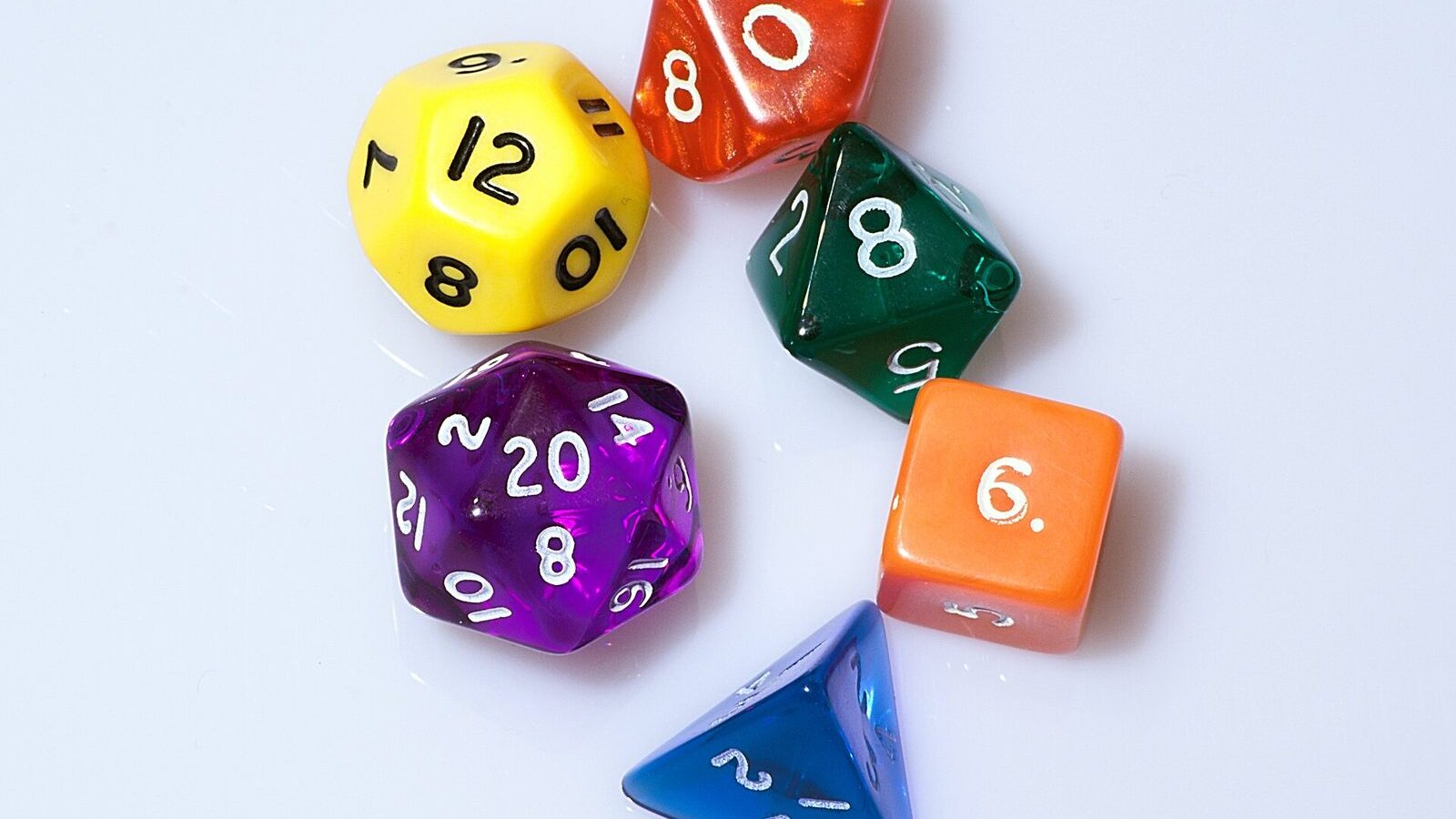
Someone has talked you into joining a game of Dungeons & Dragons, or you have a teenager who has suddenly started talking about saving throws. Either way, the first thing anyone needs is dice, and the first thing anyone asks is why there are so many odd shapes in the bag. Here is a plain guide to what you actually need, and what is just fun to have.
The standard set of seven
Most tabletop role-playing games, D&D included, use polyhedral dice. They are named with a “d” and the number of sides, so a d20 has twenty faces. A standard set has seven:
- d4: the little pyramid. Often used for small amounts of damage, like a dagger. Watch your feet, it hurts to stand on.
- d6: the ordinary cube you know from board games.
- d8: looks like two pyramids stuck together.
- d10: a slightly pointy shape numbered 0 to 9.
- Percentile d10: another ten-sided dice, numbered 00, 10, 20 and so on. Roll it with the ordinary d10 to get a number from 1 to 100.
- d12: the rounder one with twelve flat faces, which gets rolled less often than its owner would like.
- d20: the big one. Most of the important rolls in D&D, from hitting a monster to talking your way past a guard, come down to this.
One set is enough to play. Plenty of players end up with a lot more than one, but that is a choice, not a rule.
Do the colours and styles matter?
Not to the game. A plain set rolls exactly the same as a glittery one. It matters to the player, though, because dice are personal. People pick sets that match a character, a mood or a favourite colour, and it is a lot easier to spot your own dice on a crowded table when they look different from everyone else’s.
The one practical thing worth checking is that the numbers are easy to read. Some very dark or very swirly sets look wonderful but take a second look to read, which can slow things down for a new player.
Sharp edge or rounded?
Most dice have softly rounded edges and corners, so they tumble and roll nicely. Sharp edge dice have crisp corners and flat faces and look more like cut gems. They are popular as a treat or a gift, and many players keep them for special occasions. If you are buying for a younger player, a standard rounded set is a sensible start.
Extras that are genuinely useful
Once you have a set, a few extras make game night easier:
- A dice bag keeps everything together so you are not hunting for the d4 under the sofa.
- A dice tower lets you drop dice in the top and catch them in a tray at the bottom, which stops them rolling off the table and settles any arguments about a dodgy throw.
- A dice box keeps a favourite set safe, especially sharp edge dice, which can chip if they knock together.
- A large d20 is mostly for fun, but it is very satisfying to roll for a big moment.
Where to find dice in Weston-super-Mare
Tabletop gaming might not be the first thing you expect in a gothic gift shop, but it fits right in. Boston T Gaming has a shelf at The Curious Hideaway with standard and sharp edge dice sets, large D20s, dice in jars, dice towers, dice boxes and dice bags, along with pin badges, patches and decks of cards. There are painted miniatures and display pieces too, and a 3D printing service for custom gaming ideas, miniatures and accessories.
You can read more about the range on our D&D and tabletop gaming page. Stock changes, so if you are after something particular, send us a message first.
Buying dice as a present
If you are buying for a player and have no idea what they already own, a set of dice is a safe bet. Nobody has ever complained about having one more set. A dice bag or a pin badge makes a good stocking filler, and a dice tower or a painted miniature feels like a proper present. You do not need to know a bard from a barbarian to get it right.
Come and have a rummage at 15 West Street, Weston-super-Mare, near Weston College. We are open seven days a week.
Photo: Diacritica, CC BY-SA 3.0, via Wikimedia Commons.